4-Band Resistor
Resistance Value
1.0 kΩ
Tolerance: ±5%
5-Band Resistor
Resistance Value
1.0 kΩ
Tolerance: ±5%
Simple Calculator for 4-Band & 5-Band Resistors
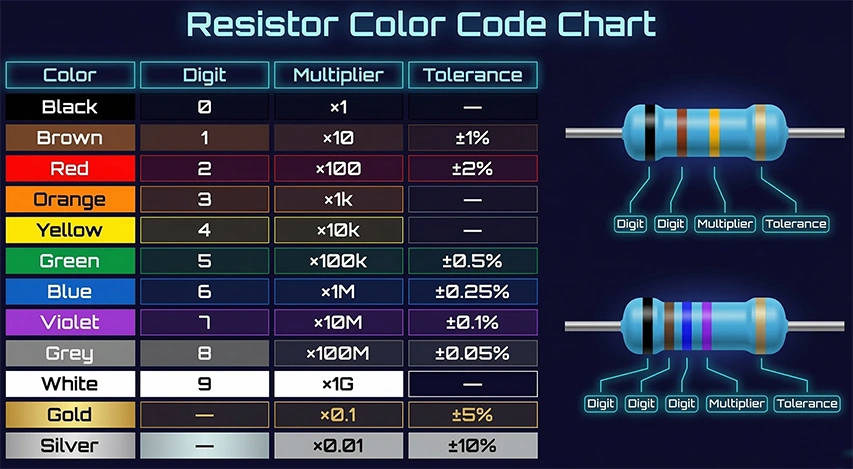
At first, resistor color bands may seem a bit confusing. But once you get the basic idea, it becomes easy to understand.
In this guide, you will learn how to read different types of resistors in a simple way.
Resistors are very small, so numbers cannot be written clearly on them. That is why colored bands are used instead. Each color represents a number, and together they show the resistor value.
This color code system has been used for many years and is still widely used today. You can read the value from the color bands easily once you understand the basics.
To read a resistor, you need to know what each color means. Each color has a number value from 0 to 9. These values help you calculate the resistance.
Gold and silver are also used in resistors. Gold means ×0.1 and ±5% tolerance, while silver means ×0.01 and ±10% tolerance.
4-band resistors are very common and easy to use. They are mostly used in basic electronic projects.
Result: 47 × 100 = 4.7kΩ (±5%)
5-band resistors are used when more accuracy is needed.
Result: 100 × 1000 = 100kΩ (±1%)
6-band resistors are used when more accuracy is needed. The first five bands are the same as a 5-band resistor, and the sixth band shows how temperature affects it.
This is called TCR. It shows how much the resistance changes with temperature. Common colors include Brown, Red, and Yellow.
Result: This is a 2.2kΩ resistor (±1%).
Sometimes people read the resistor in the wrong direction. Here are some simple tips:
When using a resistor, it is a good idea to check the tolerance. For general use, 5% or 10% works fine. But in some circuits, even a small variation can cause problems, so it's better to use 1% or 0.1% resistors there.
It's good to remember the color chart, but manual calculations can sometimes lead to mistakes. So instead of wasting time, you can use the calculator to quickly find the correct value.
What is a resistor?
A resistor is a component that limits the flow of current in a circuit.
What does the color code mean?
The color bands show the resistance value and tolerance.
Can I calculate without a calculator?
Yes, but using a calculator makes it faster and easier.
Reading resistor color codes may seem difficult at first, but it becomes easy with practice. You can also use the calculator above to save time and avoid mistakes.